 cs




How should you wash and care for clothing with DTF prints? Learn the best practices for washing, drying and ironing,...
 Petr Dvořák


 (Web) (554 × 640 px) (5).png "LeftBanner 1")


How should you wash and care for clothing with DTF prints? Learn the best practices for washing, drying and ironing,...

Which materials can DTF transfers be applied to? Learn how DTF performs on cotton, polyester, blended fabrics and...

How do you apply a DTF transfer to fabric correctly? Learn how to set heat press temperature, time and pressure, why...

Is your DTF printing process not working properly? Discover the most common DTF printing problems, including nozzle...

Which cleaning fluid should you use for a DTF printer? Learn the differences between Cleaning Fluid, Flushing Fluid...

How do you clean a DTF printer properly and prevent printing problems? A practical guide to regular maintenance of...
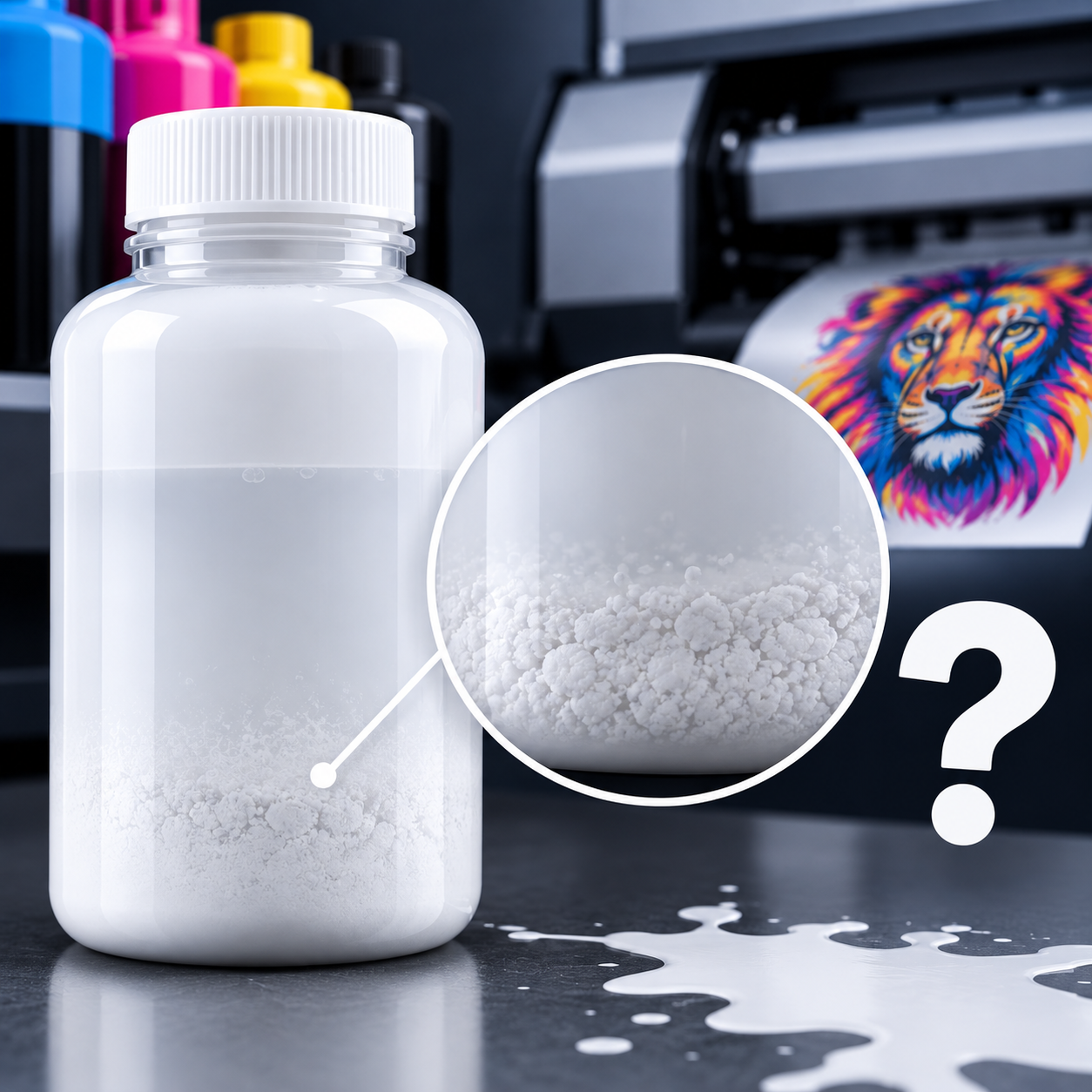
Why does white DTF ink settle, and when does sedimentation become a problem? Learn why white pigment settles, how ink...
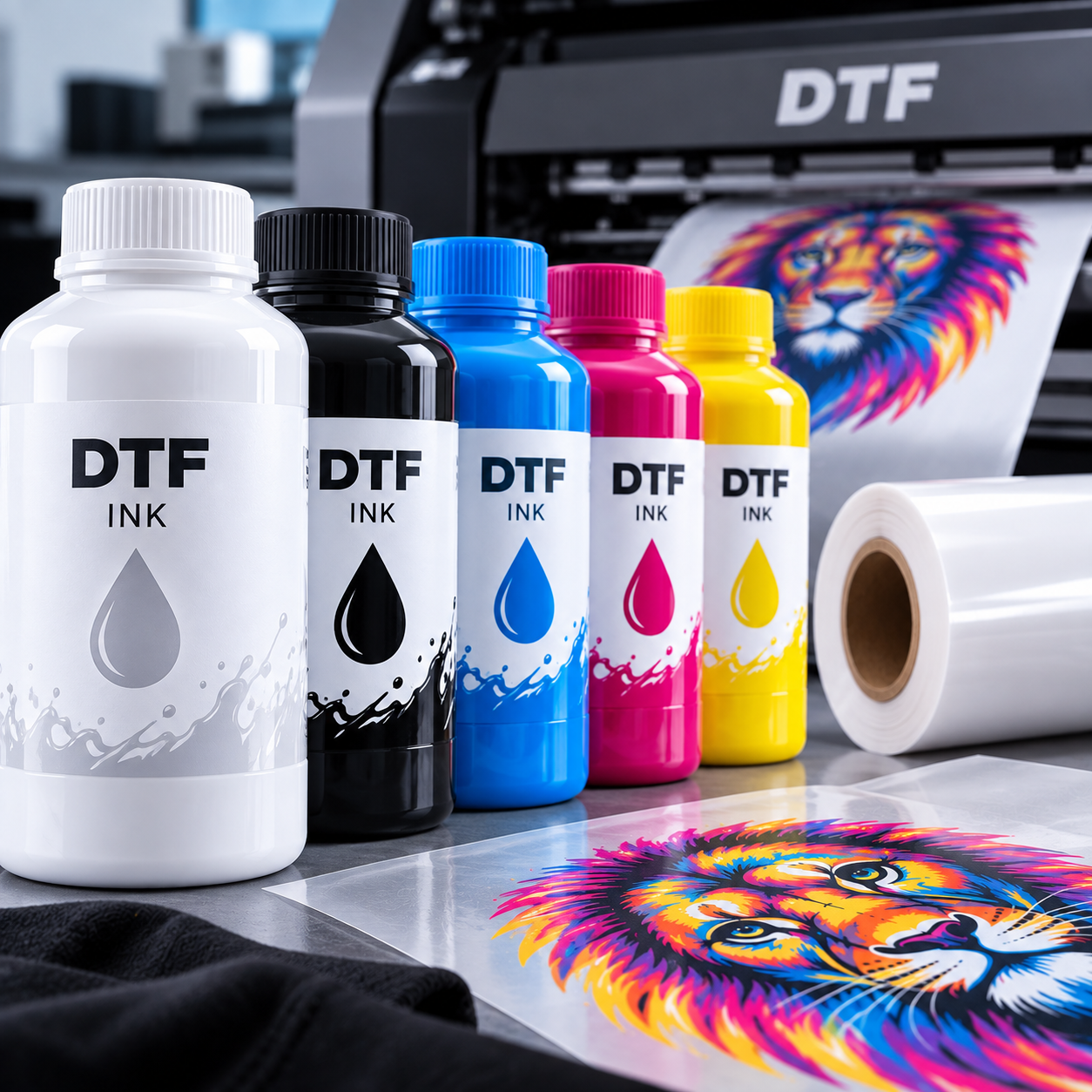
How do you choose the right DTF ink? Learn the difference between CMYK and white DTF ink, why printhead compatibility...

Is your DTF transfer peeling or failing after washing? Discover the most common adhesion problems – from DTF powder...
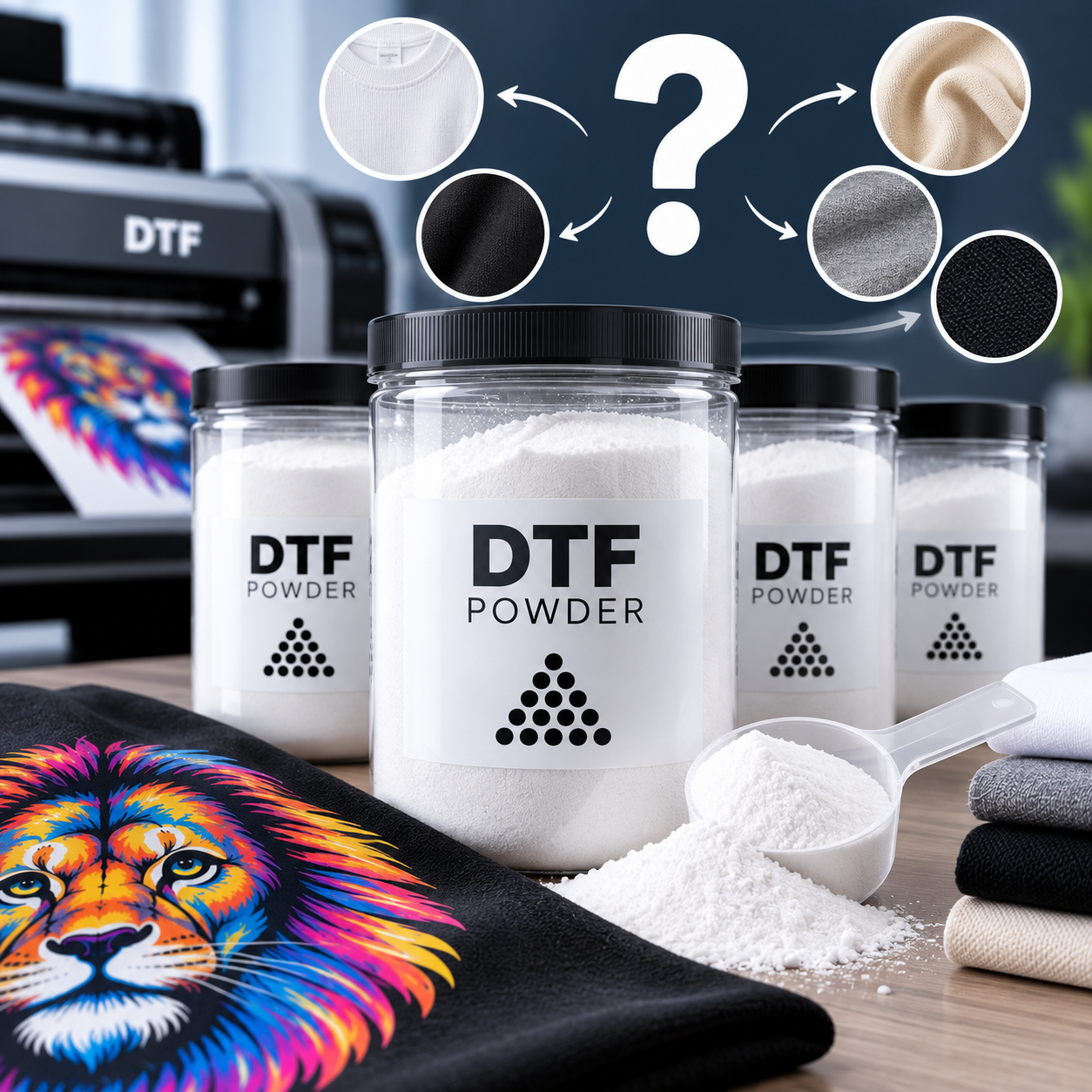
How do you choose the right DTF adhesive powder? Learn what TPU powder is, how it affects adhesion and durability,...
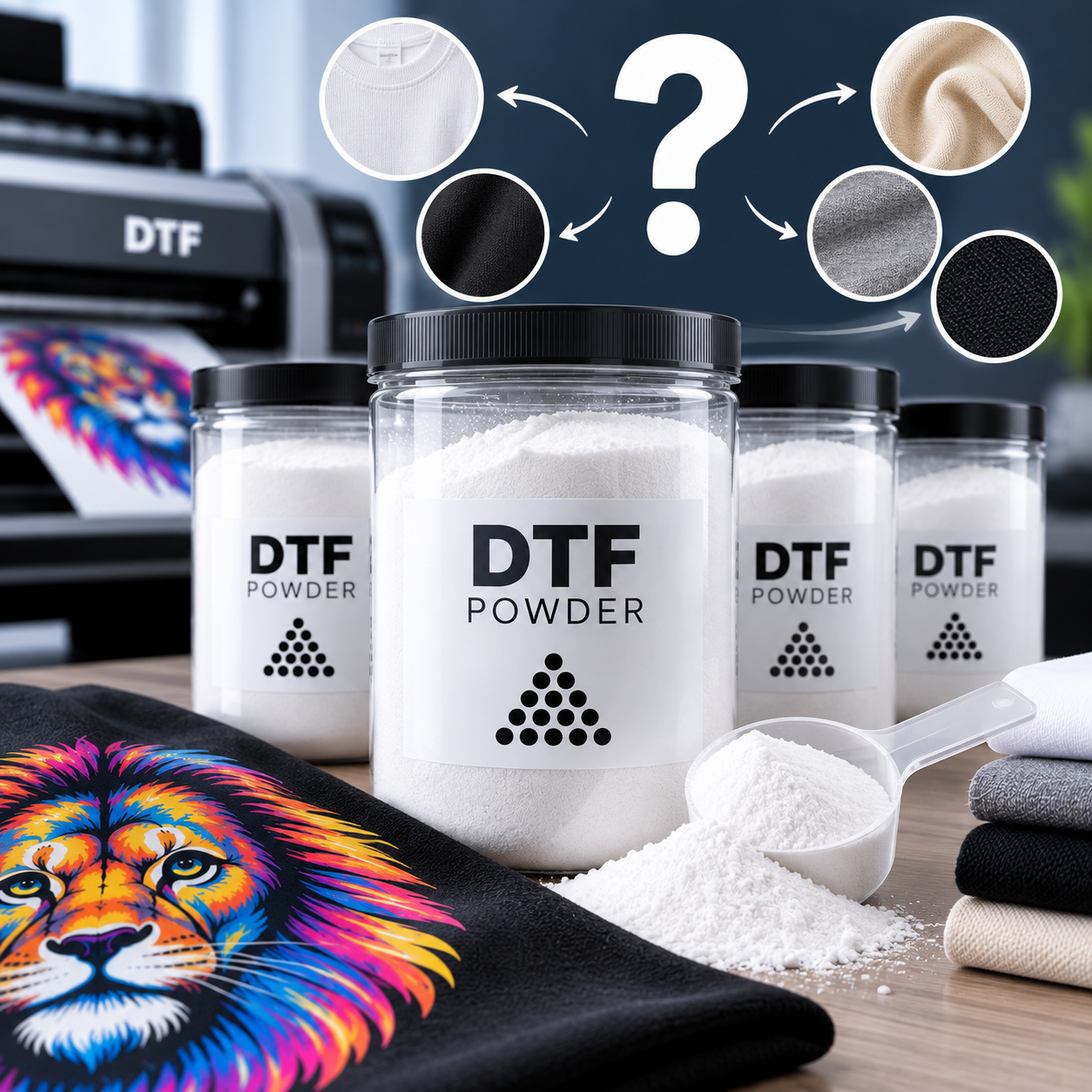
DTF adhesive powder is one of the key components of Direct to Film printing. Its purpose is to create a reliable bonding layer between the printed design and the fabric.
Choosing the right TPU powder for DTF printing can significantly affect transfer adhesion, print flexibility, durability during use and washing, and the reliability of the application process.
For this reason, price per kilogram should not be the only factor when choosing a DTF powder. Other important parameters include particle size, activation temperature, compatibility with the other components of the DTF system and, most importantly, the type of fabric onto which the transfer will be applied.
In this guide, we explain how DTF adhesive powder works, which parameters matter and how to choose the right TPU powder for your DTF production workflow.
DTF adhesive powder is a thermoplastic powder applied to freshly printed DTF film during the production of a DTF transfer.
Professional DTF systems commonly use adhesive powders based on TPU – Thermoplastic Polyurethane.
In simplified form, the process works like this:
printing the design onto DTF film
↓
applying DTF powder
↓
removing excess powder
↓
heat curing
↓
finished DTF transfer
↓
heat press application onto fabric
When heated, the adhesive powder melts and creates a bonding layer that allows the printed design to adhere to the textile.
TPU stands for Thermoplastic Polyurethane.
It is a family of thermoplastic polymers that can soften or melt when exposed to heat.
This property makes TPU suitable for use as a hot-melt adhesive in DTF technology.
For a high-quality DTF transfer, the adhesive layer needs to create a reliable bond with the textile while also providing the properties required from the finished print.
IMPORTANT: The term TPU does not mean that all DTF powders are identical. Different products can have different formulations and technical properties.
DTF powder creates the bond between the printed design and the fabric.
Its properties can therefore influence:
An unsuitable or incorrectly processed powder can cause problems that may mistakenly be attributed to the DTF film, ink or heat press.
There are many products on the market described simply as DTF powder or DTF adhesive powder.
However, this does not mean they all have the same properties.
DTF adhesive powders can differ in:
For this reason, choosing a DTF powder based solely on price is not recommended.
One of the important characteristics of an adhesive powder is its particle size.
You may encounter descriptions such as:
or a specific particle size range stated by the manufacturer.
Particle size can influence how the powder is applied, how it behaves on the printed film and the characteristics of the resulting adhesive layer.
CAUTION: Terms such as Fine, Medium and Coarse may not be standardised in exactly the same way by every manufacturer. It is therefore better to check the technical specifications of the specific product rather than relying solely on its commercial description.
No.
A very fine powder is not automatically better, and a coarser powder is not automatically worse.
The appropriate particle size depends on the specific DTF system, equipment design, powder application method, required result and the manufacturer's recommendations.
For professional production, process stability and compatibility are more important than simply choosing the finest powder available.
TIP: Whenever you change the type or particle size of your DTF powder, perform tests before starting full-scale production.
DTF adhesive powder requires heat energy to function correctly.
When heated, the powder melts and forms a continuous adhesive layer.
However, different powders can vary in the temperature range at which they begin to melt and in the conditions required for correct processing.
Our range includes professional B-Flex 100% TPU adhesive powders, where the melting process begins at approximately 110°C.
However, this does not mean that the initial melting temperature should automatically be used as a universal setting for the entire DTF production process.
IMPORTANT: Powder melting temperature, curing conditions and the parameters used to apply the finished transfer to fabric are different technical specifications. Always follow the current technical instructions for the specific product.
One of the most important principles of DTF production is:
Transfer quality is not determined by a single material, but by the correct interaction of the entire DTF system.
The individual components work together:
DTF film
↓
DTF ink
↓
DTF adhesive powder
↓
curing
↓
heat press
↓
fabric
Changing just one material can therefore affect the performance of the entire process.
For example, when changing your DTF powder, you should not automatically assume that all previous production settings will perform in exactly the same way.
This is one of the most important questions when choosing an adhesive powder.
Fabrics differ in composition, surface structure and behaviour when exposed to heat.
Different requirements may apply to:
One type of adhesive powder may therefore not be optimal for every application.
RECOMMENDED: If you work with specialist or difficult-to-bond materials, check whether the manufacturer offers an adhesive powder specifically designed for that type of fabric.
Some fabrics may require a specially formulated adhesive with higher bonding strength.
Examples can include certain nylon or surface-treated materials.
Special DTF powders are available for these applications and are designed to provide more suitable adhesion to challenging fabrics.
Using the same universal powder for every type of textile may therefore not always provide the best result.
TIP: If a transfer performs well on cotton but has adhesion problems on another material, the DTF process itself may not be the cause. The adhesive powder may simply not be suitable for that particular textile.
Check what the powder is made from and which applications it is designed for.
Consider the particle size and the manufacturer's recommendations for your production technology.
Check the recommended conditions for correct curing and processing.
The powder needs to work correctly with the DTF film, inks and curing process you use.
Consider whether you mainly work with cotton, polyester, blends or specialist textiles.
A professional material should provide repeatable results during ongoing production.
Access to a supplier who understands the materials and has practical experience with the DTF system can be extremely valuable when optimising production or troubleshooting.
DTF adhesive powder should be stored according to the conditions specified by its manufacturer.
In general, it is important to protect the material from unsuitable environmental conditions that could affect its properties and processing behaviour.
Always close the packaging properly after use and follow the storage recommendations for the specific product.
IMPORTANT: If the powder begins to behave unusually, check the condition and storage of your consumables before making major changes to printer or heat press settings.
As with DTF film, adhesive powder should not be evaluated solely on its purchase price.
Actual production costs can also include:
A cheaper material therefore does not automatically result in more economical production.
TIP: In professional DTF production, consider the total cost of producing a reliable transfer, not simply the price of one kilogram of powder.
When switching to a new DTF powder, we recommend producing several test transfers before starting full-scale production.
Test the powder with:
Evaluate not only the appearance immediately after application, but also the transfer's properties after cooling and during normal use.
For important production applications, it is also advisable to perform a wash test under the recommended conditions.
Poor adhesion does not automatically mean that the powder itself is defective or low quality.
There may be several possible causes:
When troubleshooting, it is therefore important to analyse the entire production process, rather than focusing on only one component.
DTF powder is a thermoplastic adhesive powder applied to freshly printed DTF film during transfer production. After heat processing, it forms an adhesive layer that allows the printed design to bond to fabric.
TPU stands for Thermoplastic Polyurethane. TPU-based materials have thermoplastic properties that make them suitable for use as hot-melt adhesives in DTF transfers.
No. Products can differ in formulation, particle size, thermal properties, adhesion, flexibility and suitability for different types of fabric.
No. The appropriate particle size depends on the specific production system and application. Compatibility and consistent results are more important than simply selecting the finest powder.
Not always. Some specialist or difficult-to-bond fabrics may require a different adhesive powder. Follow the manufacturer's recommendations and test the specific combination before production.
There are several possible causes, including an unsuitable adhesive, insufficient curing, incorrect application temperature or pressure, incompatible materials or the specific properties of the textile.
It describes the thermal behaviour of the adhesive when heated. The temperature at which melting begins should not be confused with the recommended curing temperature or the temperature used to apply the finished transfer to the textile.
If you are unsure which DTF adhesive powder is suitable for your production process, we will be happy to help you choose the right solution.
For a more precise recommendation, it is useful to know:
Based on this information, it is easier to determine which type of adhesive powder is suitable for your specific application.
B-Flex DTF Adhesive Powders
DTF Powder for Nylon and Special Fabrics
How to Choose the Right DTF Film? Complete Guide
Hot Peel vs. Cold Peel DTF Film – What's the Difference and Which Should You Choose?
How to Cure DTF Powder Correctly
Leave a comment